For utilities and gas infrastructure operators, the European Methane Regulation poses a challenge. They must now inspect their underground pipelines much more frequently than before, quantify gas leaks, and document them for annual reporting. The German Technical and Scientific Association for Gas and Water (DVGW) – Technical and Scientific Association (DVGW) incorporated the new requirements into its regulations in November 2025 and specified which measurement technologies are permitted (Information Sheet Series G 465-1 ff.). For the first time, the use of vehicle-mounted systems for leak detection via atmospheric concentration and wind measurements is now also approved. This means that inspection vehicles are no longer required to drive directly over the underground pipeline but can also move “off-track” in its vicinity, which allows for much greater flexibility. According to the updated DVGW regulations, the systems must demonstrate their suitability in a test before they are approved for gas pipeline network inspection.
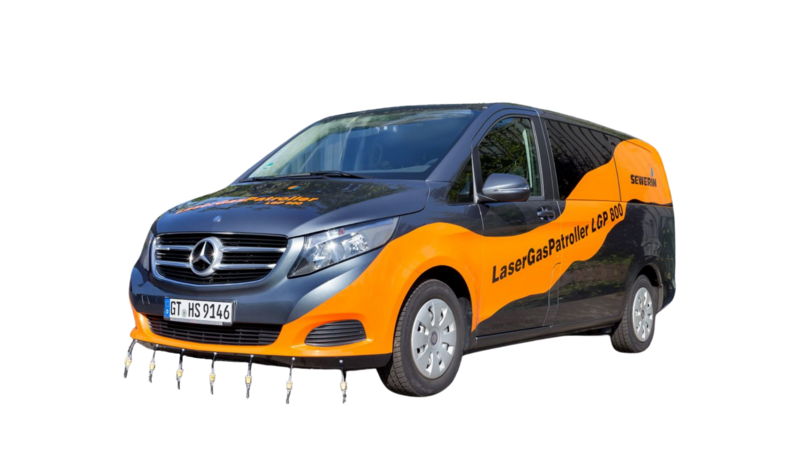
The LGP 900 Laser Gas Patroller from Sewerin is a system for vehicle-based gas pipeline network inspection, including wind measurement. According to the final report from the DVGW Research Center dated July 2026, the system passed the General Suitability Test—which verifies that the LGP 900 meets the requirements of DVGW Technical Bulletin G 465-4-4—with excellent results. The LGP 900 systematically searches for gas leaks using laser technology. It selectively detects methane with a resolution of 0.01 ppm (10 ppb) and displays this as a gas indication. The suspected area is calculated with precision. This is achieved by analyzing local wind conditions and utilizing the Global Navigation Satellite System (GNSS) in conjunction with inertial measurement sensors and real-time correction signals. The new SeCuRi® SAT 7 software generation ensures the required comprehensive documentation fully automatically and in compliance with legal requirements, while the data remains with the user at all times.
General Suitability Test
The DVGW Research Center at the Engler-Bunte Institute (Karlsruhe), in collaboration with Open Grid Europe (OGE), was responsible for developing and administering the General Suitability Test. The vehicle-mounted leak detection systems had to complete several days of measurement runs on a test field as well as field tests in the city of Regensburg under various atmospheric conditions. Only those systems that detected at least 90 percent of the gas releases in each case were approved. Four of the six vehicle-mounted measurement systems tested demonstrated compliance with G 465-4-4 (concentration and wind measurement).